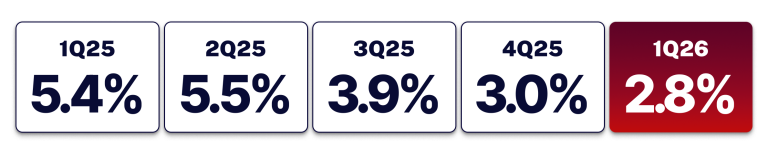
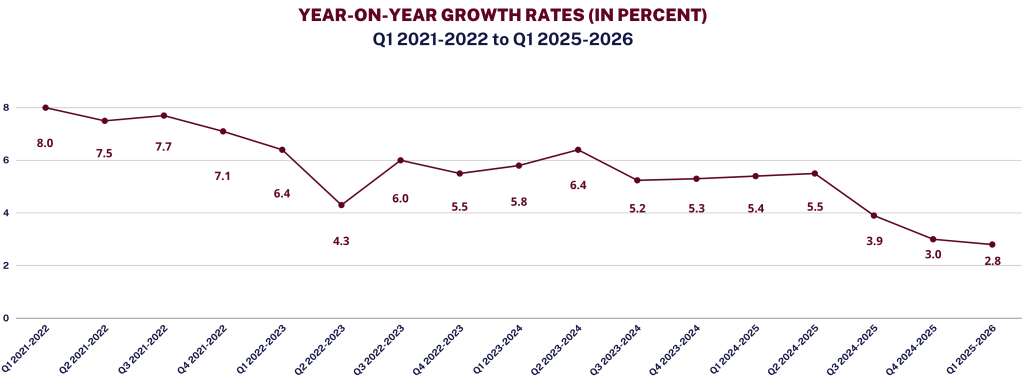
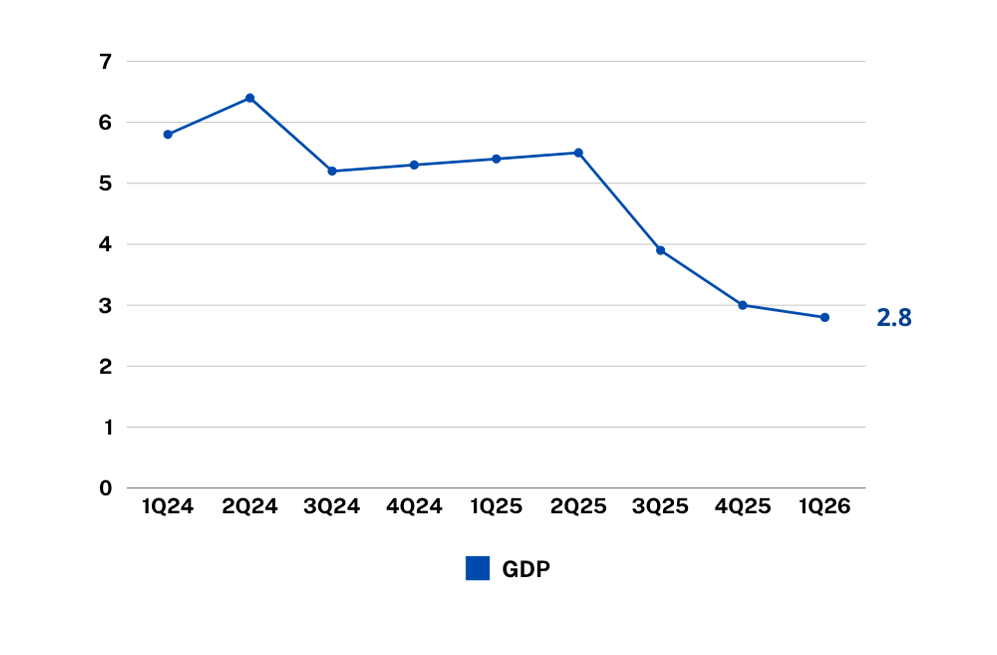
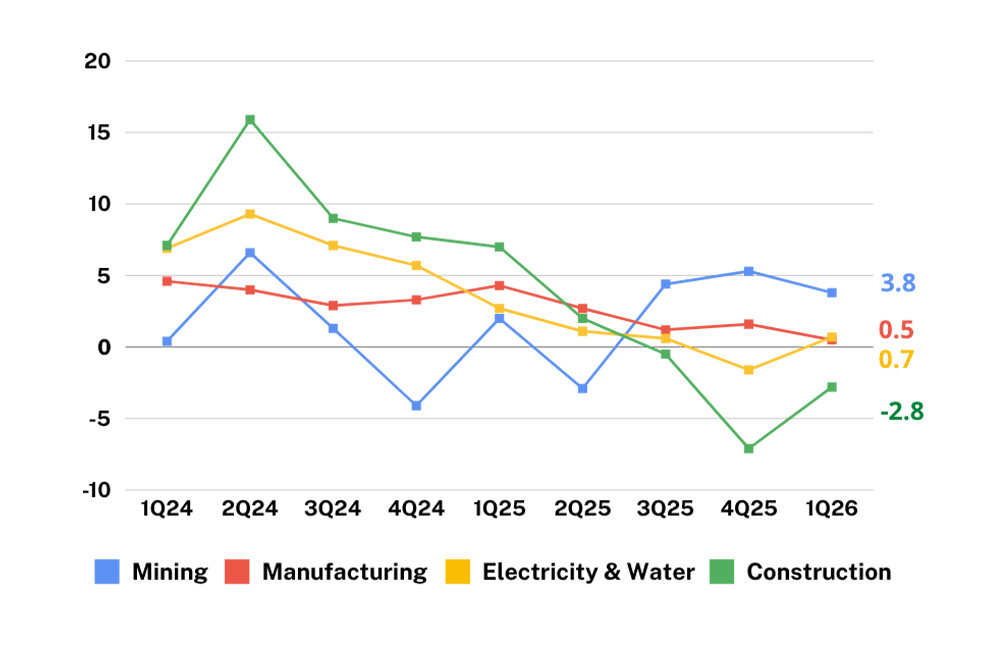
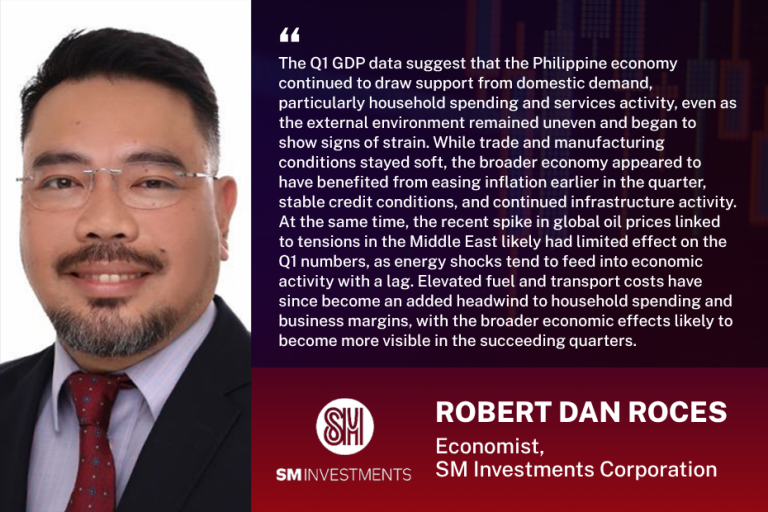
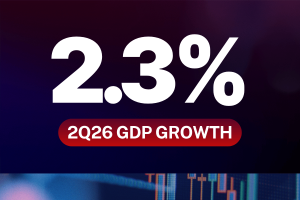
07 May 2026 — Philippine Gross Domestic Product grew by 2.8% in the first quarter of 2026, significantly lower than the 5.4% growth recorded in the same quarter last year, according to the Philippine Statistics Authority (PSA). This also marks a slowdown from the 3.0% GDP growth recorded in Q42025 which was previously recorded as the weakest quarterly growth performance of the Philippines after the pandemic period.
The GDP growth for this quarter is significantly lower than the government’s growth target of 5-6% percent for 2026. The latest figure also falls below the median forecast of economists at 3.4% for Q1 2026 signalling weakness in domestic economic activity amid lower household spending, weak industrial output, and sluggish agricultural performance largely affected by geopolitical disruptions.
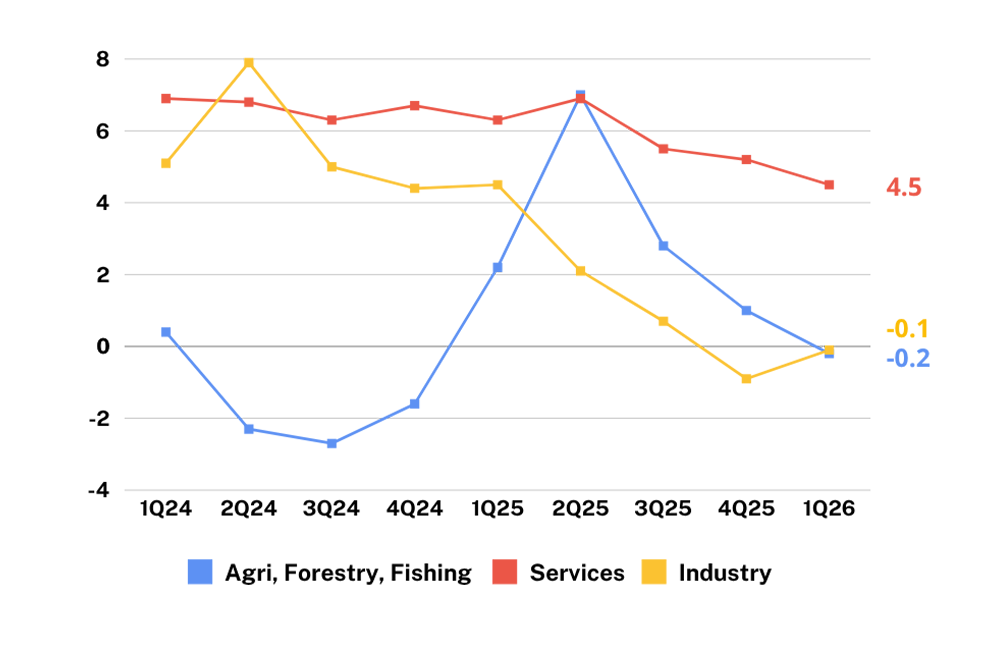
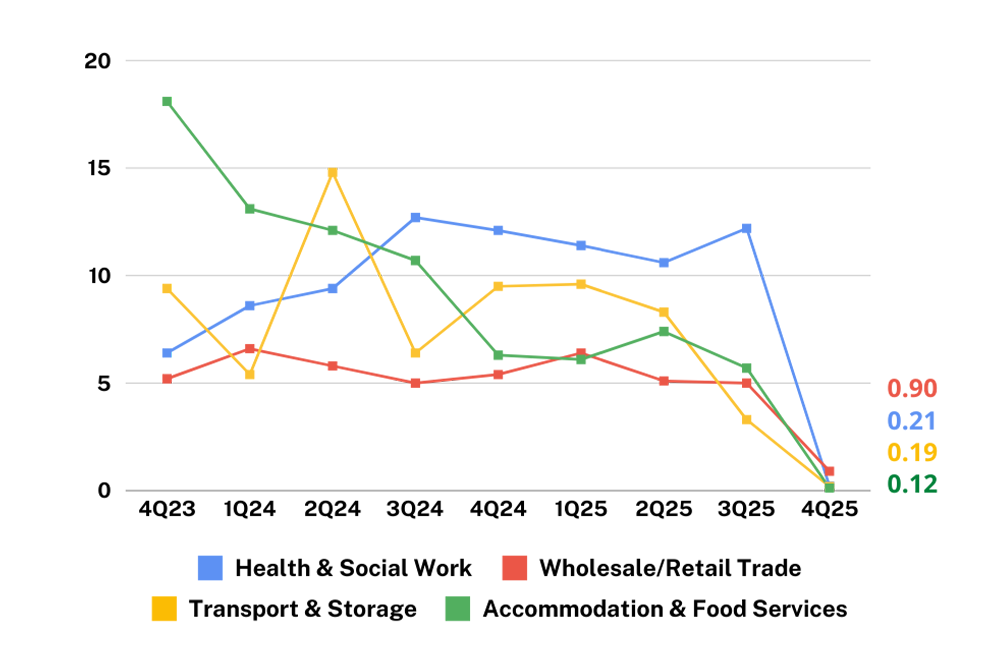
On the supply side, the services sector still remains the primary driver of growth at 4.5% and contributes 2.8 percentage points to overall GDP growth. Meanwhile, the Agriculture, forestry, and fishing sector contracted by 0.2%, while industry slightly declined by 0.1%. Among industries, the fastest-growing sectors in Q1 2026 were Public Administration and Defense; Compulsory Social Security (+8.6%), Human Health and Social Work Activities (+7.4%), Education (+6.1%), and Wholesale and Retail Trade; Repair of Motor Vehicles and Motorcycles (+4.6%). The largest contributors to overall GDP growth were Wholesale and Retail Trade (0.8 percentage point), Financial and Insurance Activities (0.4 percentage point), and Public Administration and Defense (0.36 percentage point).
On the demand side, Valuables recorded the fastest growth at 92.8% in Q1 2026, followed by Exports of Goods (+13.3%), Imports of Goods (+6.8%), and Government Final Consumption Expenditure (GFCE) (+4.8%). The sharp increase in valuables can be attributed to the acquisition of gold by the Bangko Sentral ng Pilipinas as it strengthens the country’s Gross International Reserves (GIR). The valuation levels jumped from roughly $12.7 billion in March 2025 to over $20.1 billion by early 2026 which is a possible signal that the central bank is hedging against the inflationary pressures seen in early 2026.
Household Final Consumption Expenditure (HFCE) remained the largest contributor to overall GDP growth, contributing 2.2 percentage points, followed by Government consumption at 0.8 percentage point.
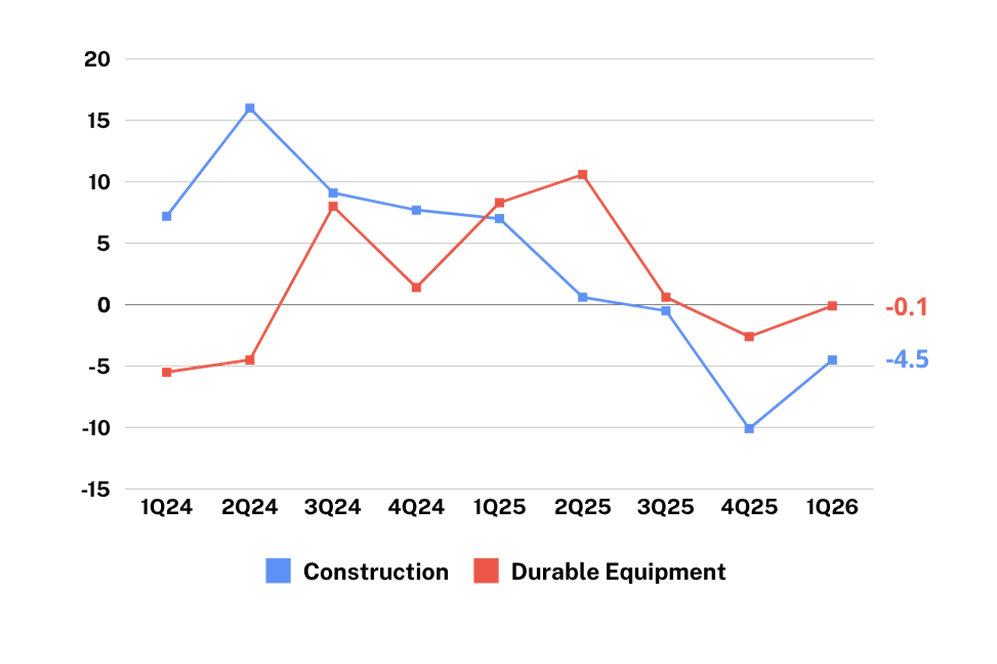
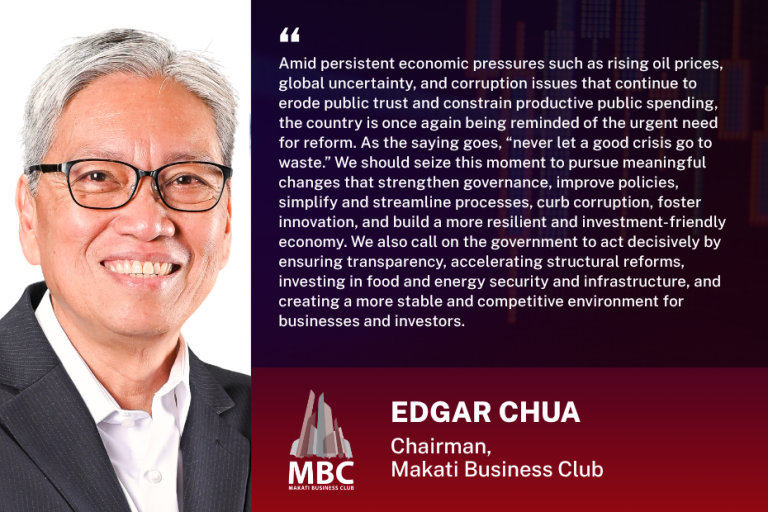
The latest GDP figures suggest that while the Philippine economy continues to be supported by the services sector and public spending, underlying growth momentum remains weak as productive sectors such as industry and agriculture continue to struggle. The Philippine economy has been slowing down since the onset of corruption investigations began in July 2025 with significant decline in public spending; this has been exacerbated by the escalation of the Middle East conflict.
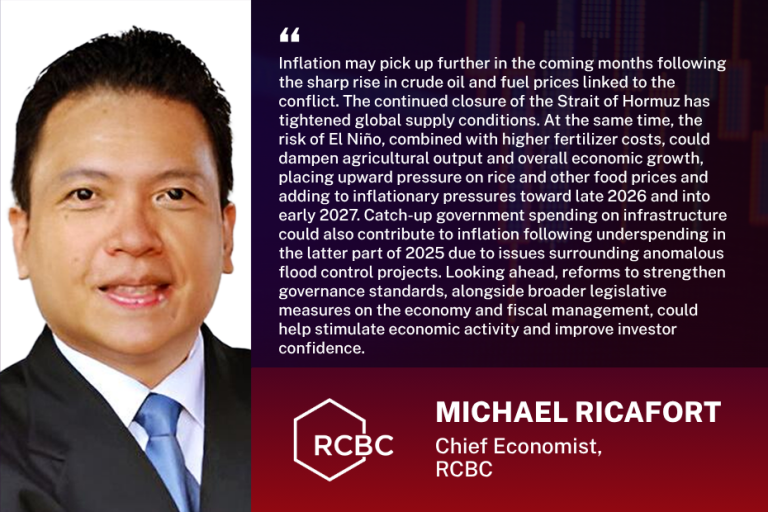
The global economy has been strained since the Iran–US–Israel Conflict escalated significantly on Feb 28, 2026 with the closure of the Strait of Hormuz where 20% of the world’s crude oil and LNG passes through. This has consequently led to massive disruption on global supply chains affecting key commodities such as energy, food, among others. The Philippines is heavily dependent on imported oil sourcing around 98% of its requirements from the Middle East and Southeast Asia. Effects were felt immediately with the Philippine peso reaching its weakest against the US dollar at Php 61. Inflation for April 2026 accelerated to 7.2%, the fastest inflation posted since March 2023.
PIDS Senior Research Fellow Jose Ramon G. Albert estimates that poverty could rise from 13.2% in 2025 to 14.4% in 2026 if oil stays at $105 per barrel pushing about 1.34 million Filipinos into poverty. If the crisis worsens and oil reaches $125, poverty could increase to 15.3% with 2.35 million newly poor, while a more severe case at $145 could raise poverty to 16.3%, affecting an additional 3.5 million people. He suggests targeted emergency cash transfers instead of fuel subsidies, noting that ₱6,000 per household could bring poverty down from 16.4% to 15.8%, helping around 754,000 people at a cost of about ₱64.6 billion.
Since the onset of the energy crisis, the government has implemented a series of measures to stabilize supply and cushion the impact of rising fuel costs. On March 24, 2026, President Ferdinand Marcos Jr. issued Executive Order No. 110, declaring a State of National Energy Emergency and authorizing the Department of Energy to safeguard energy security and mitigate global fuel disruptions within existing laws. Under its contingency powers, the DOE has been empowered to implement fuel and energy allocation plans and adopt conservation measures such as rationing, load curtailment, and restrictions on government resource use in the event of critically low supply. During this period, the DOE also imposed temporary limits on petroleum price adjustments by setting a ceiling on increases and a floor on rollbacks to manage volatility. In parallel, the government extended financial assistance or ayuda to the transport sector, expanding coverage to include delivery and motorcycle riders, to help offset the burden of high fuel costs.
There are also growing concerns about the forecasted “super El Niño” which can prospectively bring about drought in the midst of an energy crisis. President Marcos created “Task Force El Niño” in 2023 led by the The National Disaster Risk Reduction and Management Council and is set to reconvene to monitor and address upcoming issues.
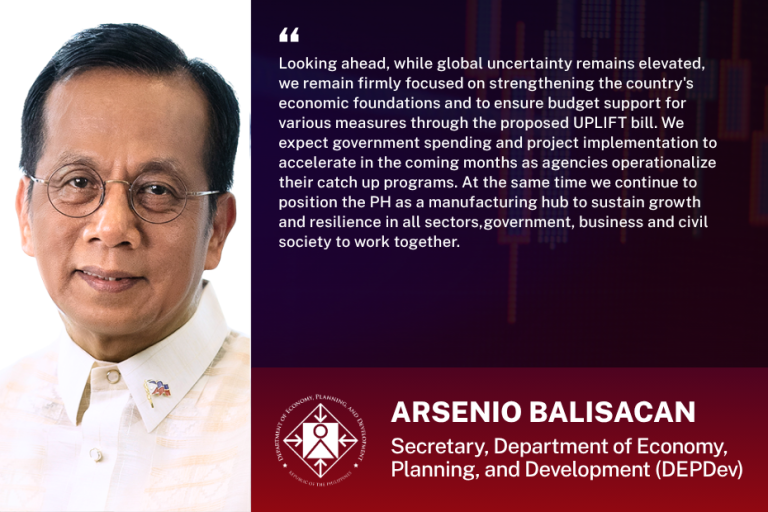
Department of Economy, Planning, and Development (DEPDev) Secretary Balisacan has also acknowledged that the slow economic growth is part of the “lingering effects of the flood control controversy with our consumer sentiment and business confidence” which has consequently led to “delays on the passage and subsequent release of the 2026 national budget slowed the roll out of critical govt programs and infrastructure projects particularly in public construction.”