"Hindi Na Sila Nahiya": A Call for the House to End Pork Barrel Politics in the Budget
Joint Statement by the People’s Budget Coalition and Roundtable for Inclusive Development on the House General Appropriations Bill Third Reading for Fiscal Year 2027 (House Bill No. 10858)
Sanggol at nanay na naghihintay ng saklolo sa bubong.
Lolang ginawang salbabida ang refrigerator sa baha.
Magsasakang tulala dahil sa mga aanihing lumubog.
Ilang libong buhay, kabuhayan, at kabahayan ang kinuha sa ‘tin ng mga pagbaha noong 2024.
Ayaw naming kutkutin ang mga sugat natin, pero binabangungot tayo at kailangan nating magising.
Nabasa na natin ang kwento at napakadilim ng ending nito. And yet, as the House crafts its version of the national budget, we find ourselves confronting a familiar darkness: closed doors, sidelined citizens, and decisions over public funds made without the meaningful participation of the people who will pay for them.
Para tayong nagsusulat ng Season 2 ng flood control scandal.
The Trillion Peso March and Baha Sa Luneta Rallies that followed the scandal made one thing clear: galit na ang mga tao. Galit na ang mga tao dahil patuloy na ginagawang tila personal wallet ng mga kongresista ang national budget na dapat sana’y Pilipino ang nakikinabang. Hindi na nahiya, hindi na natuto.
Imbis na linisin ang budget ngayong taon, lalo pang dumumi. The House of Representatives has once again inserted billions into programs that perpetuate political patronage like DSWD AICS, DOH MAIFIP, and DOLE TUPAD and doubled local infrastructure programs in the DPWH without publicly verifiable programs of work or attachments. Para mapagbigyan ang mga kapritsong ng House, binawasan ang budget para sa edukasyon, transportasyon, kalusugan, at oras ng kalamidad.
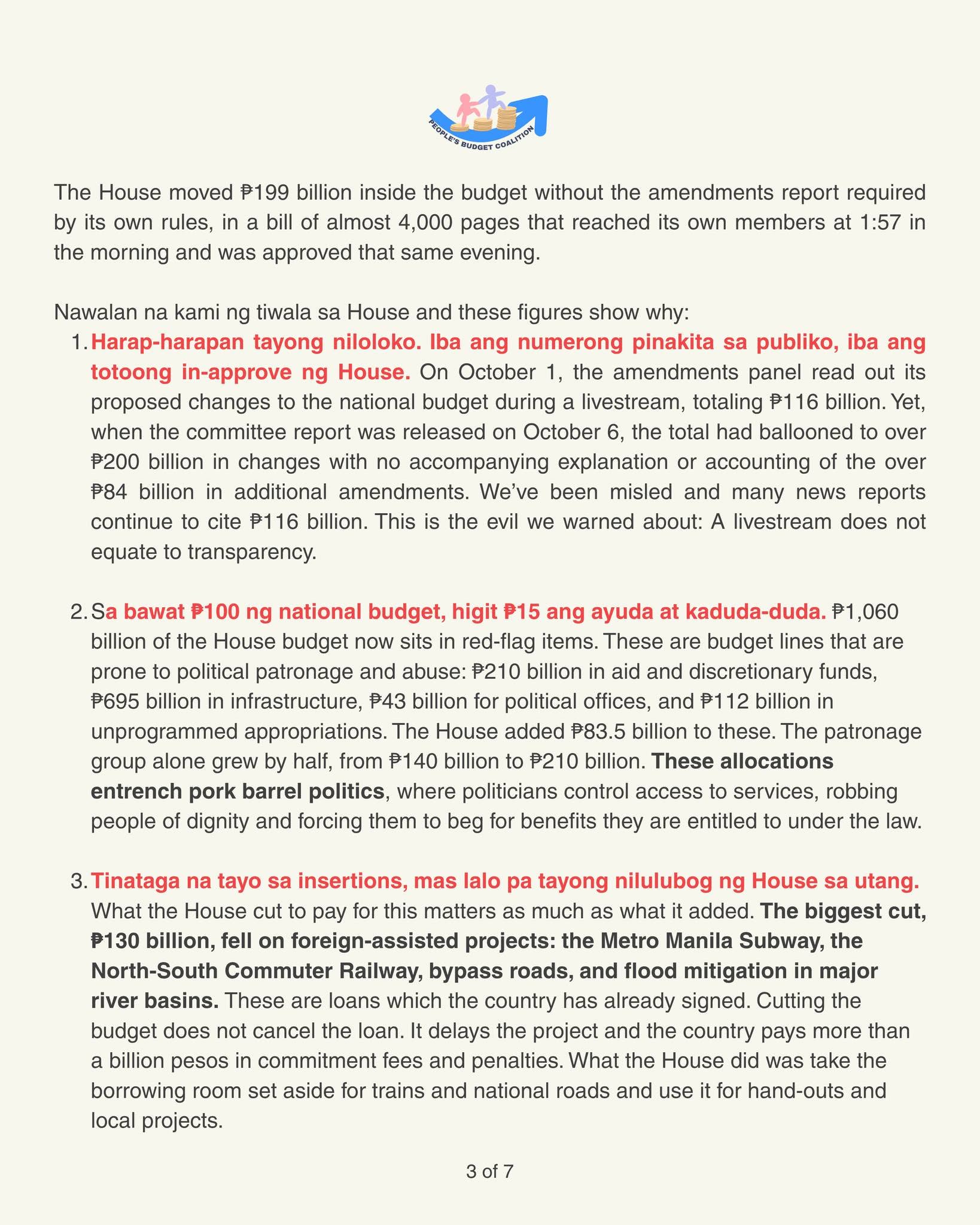
The House moved ₱199 billion inside the budget without the amendments report required by its own rules, in a bill of almost 4,000 pages that reached its own members at 1:57 in the morning and was approved that same evening.
Nawalan na kami ng tiwala sa House and these figures show why:
- Harap-harapan tayong niloloko. Iba ang numerong pinakita sa publiko, iba ang totoong in-approve ng House. On October 1, the amendments panel read out its proposed changes to the national budget during a livestream, totaling ₱116 billion. Yet, when the committee report was released on October 6, the total had ballooned to over ₱200 billion in changes with no accompanying explanation or accounting of the over ₱84 billion in additional amendments. We’ve been misled and many news reports continue to cite ₱116 billion. This is the evil we warned about: A livestream does not equate to transparency.
- Sa bawat ₱100 ng national budget, higit ₱15 ang ayuda at kaduda-duda. ₱1,060 billion of the House budget now sits in red-flag items. These are budget lines that are prone to political patronage and abuse: ₱210 billion in aid and discretionary funds, ₱695 billion in infrastructure, ₱43 billion for political offices, and ₱112 billion in unprogrammed appropriations. The House added ₱83.5 billion to these. The patronage group alone grew by half, from ₱140 billion to ₱210 billion. These allocations entrench pork barrel politics, where politicians control access to services, robbing people of dignity and forcing them to beg for benefits they are entitled to under the law.
- Tinataga na tayo sa insertions, mas lalo pa tayong nilulubog ng House sa utang. What the House cut to pay for this matters as much as what it added. The biggest cut, ₱130 billion, fell on foreign-assisted projects: the Metro Manila Subway, the North-South Commuter Railway, bypass roads, and flood mitigation in major river basins. These are loans which the country has already signed. Cutting the budget does not cancel the loan. It delays the project and the country pays more than a billion pesos in commitment fees and penalties. What the House did was take the borrowing room set aside for trains and national roads and use it for hand-outs and local projects.
“Wala nang fiscal space.” Yan ang laging sagot ng House sa bawat panukala ng mga magsasaka, mamamalakaya, komyuter, at estudyante para sa mga makabuluhang programa. Pero para sa mga multi-purpose buildings, access roads, at ayuda, may nakutkot na higit sa P200 billion. Ano ba ang totoo?
Hindi dapat nanlilimos ang taumbayan. Hindi dapat nakasalalay sa utang na loob ang pagtanggap ng serbisyong karapatan namin. We demand that the ayuda budget be reallocated to rules-based social protection, health, education, agriculture, disaster response, and public transportation, which the House cut or left untouched.
The DPWH published its proposed projects online, one by one, with publicly verifiable documents and attachments. The DBM is working with civil society to improve its budget transparency system. The President signed off on these efforts. The Senate has opened its doors to budget monitors. None of them are perfect, but all of them are trying.
But the House is not; the House is regressing. By refusing to digitize the budget process, the House has made monitoring work difficult.
We in the People’s Budget Coalition, BetterGov.PH, and our People’s Budget Research Alliance with universities have worked through sleepless nights to compare every line item across the NEP and the House second reading and third reading versions.
independently scrutinize and verify every line item. You may access them via these links:
- Overview of changes between the NEP and the House version: https://ajamontesa.github.io/ph-budget-analysis/hgab-2027-assessment.html#28_DPWH:_what_moved_inside_the_department
- Table comparing changes in 16,000+ DPWH projects (NEP vs. H-GAB 2nd vs. H-GAB 3rd): https://csiiiv.github.io/DPWH-NEP-HB-2027-ANALYSIS/app/#compare?view=paps
- Ten areas for further study by analysts: https://csiiiv.github.io/DPWH-NEP-HB-2027-ANALYSIS/app/#highlights
- Table comparing allocations per congressional district: https://research.bettergov.ph/static/nep-preview/congress.html
- (For technical analysts) Eight partial and unofficial flags for public works, farm to market roads, irrigation, and health facilities: https://research.bettergov.ph/static/nep-preview/
Meanwhile, we call on the branches of government to check the abuses of the House.
To DBM Secretary Kim De Leon and all Executive agencies, we call on you to defend your 2027 proposed budget against this bastardized House version. The latter disregards your vision and meticulously prepared plans for the following year. We call on you to do your part: to account for these insertions, disclose what cannot or should not be implemented, and be transparent with the Filipino people.
To DPWH Secretary Vince Dizon, we call on you to check the House’s version of the budget and determine which of these are truly science-based. After the nightmare of the flood control scandal, we believe in your leadership and your sincere efforts to restore public trust in the process. But your efforts risk being wasted in the face of the House’s overwhelmingly mangled budget. The agency cannot rebuild public trust while being made to carry a budget whose changes it cannot adequately explain or defend.
The House has likely:
- inserted 5,804 new projects worth P162 billion,
- deleted 1,068 projects worth P68 billion,
- increased 203 projects in the NEP worth P5 billion, and
- decreased 206 projects in the NEP worth P87 billion.
- Compared to the NEP which had 11,420 projects worth P573 billion, the House 3rd reading version has 16,275 total allocations worth P587 billion.
To the Senate, especially Finance Committee Chair JV Ejercito and Senate President Win Gatchalian, our hope rests with your chamber. We call on you to exercise your power of scrutiny: hold the House accountable for every amendment, restore funding for the people’s priorities that were cut or neglected, and reject any amendment that comes without a clear, complete, and publicly accessible report. We will work with you tirelessly so that the opacity and darkness of the House does not reach the halls of the Senate.
To President Marcos Jr., we call on you to veto amendments that cannot withstand public scrutiny. Delete any insertion that reaches your desk: those without a clear project list, supporting documents, or a defensible justification. A lean, implementable, and accountable budget is better than a bloated one that repeats the very practices that gave birth to the flood control scandal.
Sinabihan po ninyo ang mga may pakana ng flood control scandal na “mahiya naman kayo.” Pero hindi sila nahiya. We call on you to complete what you started. Defend the budget your administration proposed. Direct the DBM and your Cabinet to publicly account for the changes made to your proposed budget and speak up for the agencies and essential programs whose funding was cut or left unaddressed. Do not let the reforms you promised end where political accountability begins. You wield the power to reject these unjustifiable insertions.
To every citizen, demand answers. Join us in scrutinizing every project. Ask your representatives what happened to theè programs that matter to your communities, why essential services were left underfunded, and who stands to benefit from amendments that cannot be publicly justified. Do not allow billions in unexplained changes to pass without scrutiny. Our taxes are not political favors. Our national budget cannot be anyone’s personal wallet.
We insist that legislators do their sworn duty: exercise the power of the purse responsibly. We demand:
- An end to pork barrel politics. Either transform programs vulnerable to political capture into transparent, rules-based programs, or scrap them altogether. No lump sum should be released without a published project list.
- A full public accounting of every amendment. Publish every increase, every cut, and the name of the legislator who proposed it, as the House’s own rules require. A livestream is not a report.
- A restoration of funds for what people receive by right. This includes (a) rules-based social protection such as the 4Ps and PhilHealth; (b) disaster response, vaccines, health facilities, and classrooms; (c) meaningful support for farmers and fisherfolk; and (d) public transport.
- Independent scrutiny of the budget by citizens. Pass the CADENA Act—which has been languishing in the House for nine months after Senate approval—and publish the budget as open data at every stage. Last year we asked the House to build an open budget transparency server. It did not. Civil society is now building its own, along with the Senate.
Public office is a public trust. Every peso misused for political gain betrays that trust. Sawa na ang Pilipino sa bulok na sistema ng national budget. Kaya na nating ituro kung saan at ano ang bulok sa sistemang ito: by page number and by peso amount. We refuse to let our 2027 budget become a playground for patronage and corruption again, one year after a trillion-peso flood scandal.
Buwis natin ito. Boto natin ito. Budget natin ito.
Organizations as of Oct. 12, 2026, 1 PM
- People’s Budget Coalition
- Roundtable for Inclusive Development
- Move As One Coalition
- Green Party of the Philippines – Kalikasan Muna
- Kabataan Para Sa Kalikasan – KALIKAS / Green Youth PH – GYP
- Bayanihan Para Sa Kalikasan Movement, Inc.Amplify-Ed Budget Initiative
- Make It Safer Movement
- Living Laudato Si’ Philippines
- Bunyog Party
- Green Convergence
- Negrosanon Initiative for Climate and the Environment (NICE)
- Alliance of Women for Action Towards Reform
- Bisig Pilipinas – Tagaytay City and Cavite
- PHINMA Education
- Makati Business Club
- Samahan ng Nagkakaisang Pamilya ng Pantawid (SNPP)
- Philippine Anti-Discrimination Alliance of Youth Leaders (PANTAY)
- Creators Against Corruption (CAC)

A Philippine Perspective on Renewable Energy at the SEA Green Economy Roundtable
A Philippine Perspective on Renewable Energy at the SEA Green Economy Roundtable August 4, 2026 — Bain & Company, along with Makati Business Club and
Turning resilience into advantage: key themes from the Makati Business Club x Kearney roundtable on navigating global recalibration
Turning resilience into advantage: key themes from the Makati Business Club x Kearney roundtable on navigating global recalibration September 22, 2026 — The Makati Business
The 2030 Enterprise: Unlocking Value through Agentic AI and Core Workflow Integration
The 2030 Enterprise: Unlocking Value through Agentic AI and Core Workflow Integration July 16, 2026 — Following its recent executive roundtable, “The 2030 Enterprise: An