Lessons from 2025: Clean Governance is Good Economics
26 January 2026 – 2025 started off with a major controversy surrounding the National Budget, which had been approved by a closed bicameral committee. The Makati Business Club declared that the budget had been “hijacked” by patronage politics. The midterm elections in May 2025 were seen as the key driver for questionable budget increases:
The 2025 GAA included a Php 1.1 trillion budget for the Department of Public Works and Highways (DPWH), equivalent to a net increase of almost Php 289 billion from the previous year. This was higher than the budget of the Department of Education, which was a violation of the constitutional rule mandating that the highest budgetary priority should be for education.
Congress also gave itself a budget increase of Php 19 billion with no clear explanation for the increase.
There was a Php 26 billion allotment for the Ayuda Para sa Kapos sa Kita Program (AKAP), a cash subsidy to “near-poor” families with no clear implementation guidelines, conditionalities, or list of target beneficiaries.
The Department of Economy, Planning and Development (DEPDev) had set a target for GDP growth at 5.5 to 6.5%. Q1 2025 started with a slight uptick of 5.4% (from 5.3% the previous quarter), due to election spending. There was also an 18.7% surge in government spending. While Q2 sustained at 5.5%, GDP growth fell to 4% in Q3, announced in November, way below target and economic forecasts. This was a result of the corruption scandal that erupted during the President’s State Of The Nation Address on July 28, after which government put infrastructure spending on hold, pending investigations by the Senate, the House of Representatives, the Department of Justice, and the Office of the Ombudsman. These resulted in a –26.2% public construction expenditure for Q3.
The President made leadership changes in key government agencies, and created the Independent Commission for Infrastructure (ICI), which was tasked to look specifically into flood control projects.
In September, the Bangko Sentral ng Pilipinas (BSP) reported that net inflows of foreign direct investments (FDI) into the Philippines had fallen to the lowest monthly level in over five years. This shows that beyond the contraction in public spending, foreign investors were holding back due to rising political uncertainty. According to a 2018 study by the UN’s Office on Drugs and Crime and the Organisation for Economic Co-operation and Development (OECD), 10-25% of the value of public contracts is lost to corruption. This translates to $2.35 trillion globally on an annual basis worth of economic loss to corruption of contractors. Those numbers could be higher today, in 2025. Therefore, investing in transparent procurement, anti-corruption measures, digitalization, and ease of doing business are critical.
It is important to note that the absence or reduction in corruption do not automatically translate to economic growth. It is important for the government to focus on (1) implementing recently passed economic reforms (2) passing needed reforms in both economic and governance spheres and (3) ensuring ease of doing business and transparency mechanisms.
The benefits of recently passed economic reforms will not have positive effects without proper implementation and improvements in the ease of doing business. These reforms include:
- Opening of renewable energy to 100% foreign equity
- The CREATE Act, the TRAIN Act, and ease of paying taxes
- The E-governance act.
- The Konektadong Pinoy act
The Philippine economy has already been significantly liberalized in the last few years through the reforms mentioned above. The Makati Business Club believes that the most critical areas should be in transparency, governance, and ease of doing business:
- People’s Freedom of Information – The Freedom of Information (FOI) bill aims to ensure unrestricted public access to official government records, documents, and research data, promoting full transparency in government transactions. Additionally, all government agencies must actively disclose certain information within their offices and on their websites.
- Amendments to the Bank Secrecy Law – Senate Bill No. 1047 aims to allow the Bangko Sentral ng Pilipinas (BSP) and the courts to look into bank accounts that are suspected of being involved in serious crimes such as bribery, fraud, or money laundering. Under the proposal, the BSP can check bank deposits if there is a reasonable reason to believe that illegal or suspicious activities are taking place. Any review of bank accounts must first be approved by the BSP’s Monetary Board and can only be done for official purposes, such as investigating financial crimes or dealing with banks that have already been closed. This can be a significant step towards combatting corruption.
- Improving implementation of the Ease of Doing Business Act – After the passage of the Ease of Doing Business (EODB) and Efficient Government Service Delivery Act of 2018 (RA 11032), one of the key provisions of the law is the mandated establishment of an electronic business permitting and licensing system. The electronic version must be available three (3) years upon the effectiveness of the law; however, as of May 2025 only 115 out of 1,642 LGUs in the Philippines have complied with requirements of the e-BOSS (electronic Business One-Stop Shop). ARTA also has no direct authority to penalize non-compliant agencies or LGUs hence implementation levels still vary.
- Ensuring continuity in budget process transparency – The government should ensure continuity in budget process transparency by institutionalizing recent reforms that have opened the 2026 national budget process to greater public scrutiny. This includes sustaining the participation of civil society organizations in budget hearings, maintaining public access and livestreaming of bicameral conference committee deliberations, and ensuring the timely publication of budget documents and tracking tools online. A more transparent budget process can improve the quality of public spending, boost investor confidence, and ensure that resources are directed toward programs that support inclusive growth and long-term development.
In MBC’s view, the quality of governance plays a decisive role in determining whether economic growth translates into real improvements in investment, jobs, and public services. Transparent, accountable, and rules-based institutions reduce corruption, improve public service delivery, and create a more predictable environment for investors, helping lower the cost of doing business and attract long-term investment.
While the Philippines has already enacted important economic reforms in terms of liberalizing key sectors, improving tax administration, and strengthening digital government, these gains will be maximized only if they are matched by governance and transparency reforms. Strengthening transparency, enforcement, and institutional capacity will help ensure that economic reforms are effectively implemented and that their benefits reach businesses, workers, and communities across the country.
The role of the Makati Business Club and other similar organizations as watchdogs and thought leaders is all the more important. Holding both public officials and fellow private stakeholders accountable to the highest standards of integrity will attract not just any investor, but the right kind of investor—one who is here to build, create skills transfer, and create quality jobs that will uplift the lives of Filipinos.
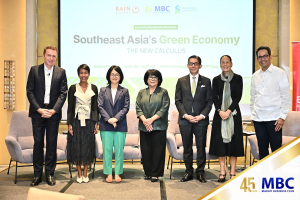
A Philippine Perspective on Renewable Energy at the SEA Green Economy Roundtable
A Philippine Perspective on Renewable Energy at the SEA Green Economy Roundtable August 4, 2026 — Bain & Company, along with Makati Business Club and
Turning resilience into advantage: key themes from the Makati Business Club x Kearney roundtable on navigating global recalibration
Turning resilience into advantage: key themes from the Makati Business Club x Kearney roundtable on navigating global recalibration September 22, 2026 — The Makati Business
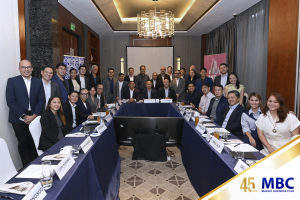
The 2030 Enterprise: Unlocking Value through Agentic AI and Core Workflow Integration
The 2030 Enterprise: Unlocking Value through Agentic AI and Core Workflow Integration July 16, 2026 — Following its recent executive roundtable, “The 2030 Enterprise: An