02 July 2026 – In the heart of Siena, the Palazzo Pubblico is home to a 14th century mural by Ambroglio Lorenzetti known as the Allegory and Effects of Good and Bad Government. It is one of the best-known early pieces of secular art, covering political subjects, rather than traditionally religious ones. The historic piece — placed in the Sala dei Nove, or Room of The Nine — was commissioned by the city’s ruling magistrates to serve as a stark reminder of the consequences of leadership and designed to visually educate citizens on the common good.
The artist’s message was clear and simple: decisions driven by civic values meant the city was governed well, and all would benefit. Conversely, caving to the temptations of tyranny would result in collective misfortune.
The mural spans the room’s three walls: the West wall is an allegory of bad government and its effects, where justice lies at the feet of an infernal Tyrant who governs only for himself. He is surrounded by Cruelty, Deceit, Fraud, and Fury. Fear looms over citizens – buildings destroyed, merchants robbed, and the landscape barren. The North wall is an allegory to good government where the central figure of Justice is seated on a throne, guided by Divine Wisdom, and flanked by Temperance, Prudence, Courage, Magnanimity, and Peace. The East wall depicts the effects of good government – a thriving and secure community where artisans work, merchants trade, citizens dance in the streets, farmers cultivate, and livestock graze in peace.
The fourth wall has a large window looking out into the city’s main square, a view into the real world where the impact of choices made in the room would be felt. Surrounding the town’s decision-makers as they went about the day-to-day business of governing was a larger-than-life illustration of what the implications of their policy decisions might be.
While the citizens of Siena were not able to physically join the deliberations of The Nine, the mural allows for their representation in a way, as its imposing presence reminded the governing body to bear in mind the welfare of the greater public as they deliberate on the matters that affect their lives.
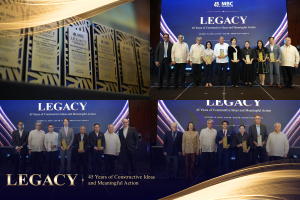
Today, citizens are afforded more direct ways of participating in governance. For the last 45 years, the Makati Business Club (MBC) has worked to find ways to constructively engage government and contribute to overall economic and development objectives.
In recent years, many initiatives have focused on granting citizens greater access to information and creating platforms to increase citizen participation in governance.
Recognizing that the National Budget is government’s most potent policy tool, MBC formally pushed for more civil society participation in the budget process in a General Membership Meeting last year. This resulted in an open bicameral conference committee meeting on the 2026 National Budget where the proceedings — historically a closed “black box” and where the 2025 GAA’s unprogrammed insertions and other allocations were quietly executed — was opened to online observers. Increasing the participation of external observers and openness to public scrutiny is one of many crucial reforms necessary to deter corrupt budget practices.
After decades stalled in Congress, the Right to Information Act has advanced further than any access-to-information measure before it, with the House passing it on Third Reading last June. MBC helped move the passage through briefings with legislative staff, business and civil society coalitions and inputs to Technical Working Group hearings. Access to credible and verifiable information is critical economic infrastructure that lowers risk and transaction costs for investors while challenging the culture of opacity that enabled the flood-control scandal.
Moving forward, MBC sees more opportunities for citizens to engage government:
- It will continue to advocate for and closely monitor the final passage of the Right to Information Act, ensuring that the current provisions are preserved, especially those creating an independent RTI Commission.
- To complement its work in participatory budgeting, MBC hopes to help the Commission on Audit strengthen and institutionalize its Citizen Participatory Audit (CPA) Program with methodological improvements, capacity building, knowledge products, and policy recommendations to further expand participatory public auditing.
- Lastly, the public is invited to make use of MBC’s interactive budget portal [https://phbudget.shinyapps.io/PHBudget/], created in partnership with Layertech Labs and Bicol University, which looks to empower researchers, advocates and ordinary citizens through a better understanding of public spending and consequently, more substantive engagement in budget-related discussions.
Building the nation we want requires a whole of society approach. An informed, engaged private sector and citizenry is a vital component of this effort.
Julia Andrea R. Abad is the Executive Director of Makati Business Club
This article was published under the Business Matters Column of INQUIRER on July 2, 2026. Business Matters is a project of Makati Business Club.