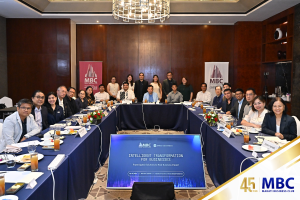
July 16, 2026 — Following its recent executive roundtable, “The 2030 Enterprise: An AI-First Business Model,” the Makati Business Club (MBC), in collaboration with IBM Philippines, shared insights on how business leaders can move beyond basic automation and prepare for a future where AI is increasingly integrated into core enterprise operations. The discussion explored how organizations can embed AI into workflows while maintaining governance, accountability, and human oversight.
The Shift to Agentic AI and Autonomous Workflows
IBM Philippines Country General Manager Leo Capinpin said AI in the enterprise is expanding beyond content generation and question-answering toward agentic systems that can plan and execute tasks in pursuit of a defined goal.
As organizations look toward the enterprise of 2030, Capinpin said leaders will need to consider how AI agents can work alongside human workforces, while maintaining appropriate oversight and accountability. He emphasized that trusted data, governance, and clearly defined responsibilities will become increasingly important as AI systems gain greater autonomy.
Highlighting the scale of this transition, IBM ASEAN’s Chief Technology Officer and Director of Pre-sales Engineering Kitman Cheung highlighted a recent IBM Institute for Business Value report showing that global business leaders surveyed expect AI investment to increase by 150% between now and 2030. He also noted that task-specific AI agents are increasingly being embedded into enterprise applications to automate processes.
Rethinking Strategy: The Purpose-Built, AI-First Model
The report by IBV indicates that organizations are increasingly looking beyond productivity gains, with respondents expecting a growing share of AI investments to focus on innovation, new operating models, products, and revenue opportunities by 2030.
Drawing parallels to previous technological disruptions like ATMs, the internet, and mobile computing, Cheung said AI represents another fundamental shift capable of redefining how organizations operate.
He encouraged organizations to view AI not as a standalone tool, but as a strategic capability that can be embedded into business processes. He added that organizations should prioritize purpose-built and smaller models, combined with governed data, hybrid cloud infrastructure, and enterprise-wide governance frameworks can help organizations scale AI more effectively.
Because of this evolving landscape, Cheung noted that “AI doesn’t automatically equal prosperity.” He emphasized that organizations are more likely to realize value when AI is integrated into core workflows and aligned with broader business objectives, rather than deployed as a simple add-on technology.
Human Ownership In the AI Era
During the discussion, an executive from the healthcare sector raised concerns about the pace and workplace pressures associated with AI adoption. In response, Cheung shared how IBM encourages employees to experiment with AI through an annual company-wide hackathon, where teams develop ideas to improve their own work. He said giving employees a role in shaping AI use cases can help build ownership and engagement as organizations navigate change.
Governance, Security, and Digital Sovereignty
Turning to the importance of governance, Capinpin noted that the rapid rise of autonomous systems require organizations to strengthen oversight and maintain visibility into how AI is being used.
Organizations, according to Capinpin, will need frameworks that help them understand how AI models are operating, what data is being used, and how accountability is maintained across automated workflows.
Cheung said these governance requirements are closely linked to digital sovereignty, or an organization’s ability to retain control and authority over its technology systems and ecosystems, data, operations and AI, while being able to demonstrate that control when needed.
Addressing workforce readiness, Capinpin emphasized that AI adoption requires more than technical skills.
He noted that critical thinking, adaptability, problem-solving, and leadership will remain essential as organizations integrate AI into business processes. He also stressed that AI initiatives should be treated as enterprise-wide efforts involving technology, operations, human resources, and risk management functions. While AI may increasingly automate tasks and decisions, Capinpin emphasized that accountability cannot be delegated. He said, “At the end of the day, you will still hold the human accountable and hold your company accountable.”
Balancing Innovation, Trust, and Accountability
In closing, Capinpin summarized the discussion with one word: governance.
As AI becomes more capable and autonomous, organizations will increasingly be challenged to determine where human judgment remains essential, how accountability is assigned, and how innovation can be balanced with trust.
The gathering marked the first session in a two-part roundtable discussion hosted by MBC and IBM Philippines, aimed at helping executives and business leaders navigate the transition from AI experimentation to building AI-first enterprises.