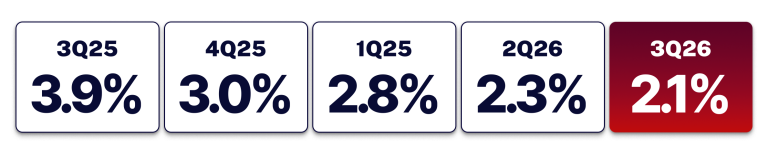
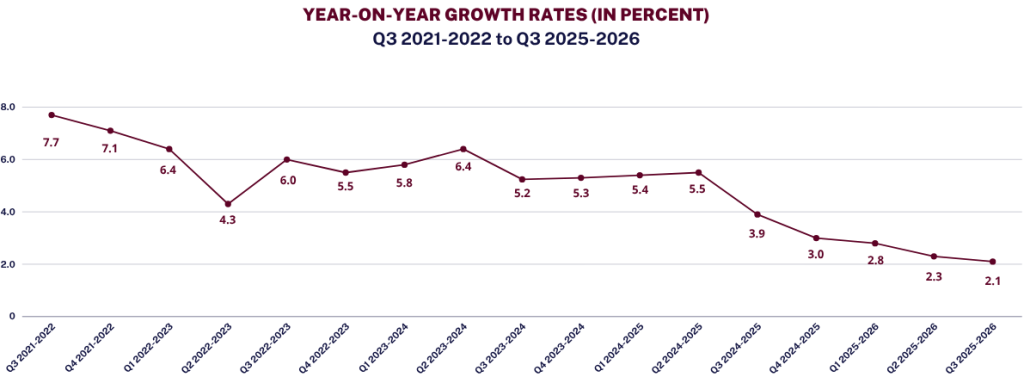
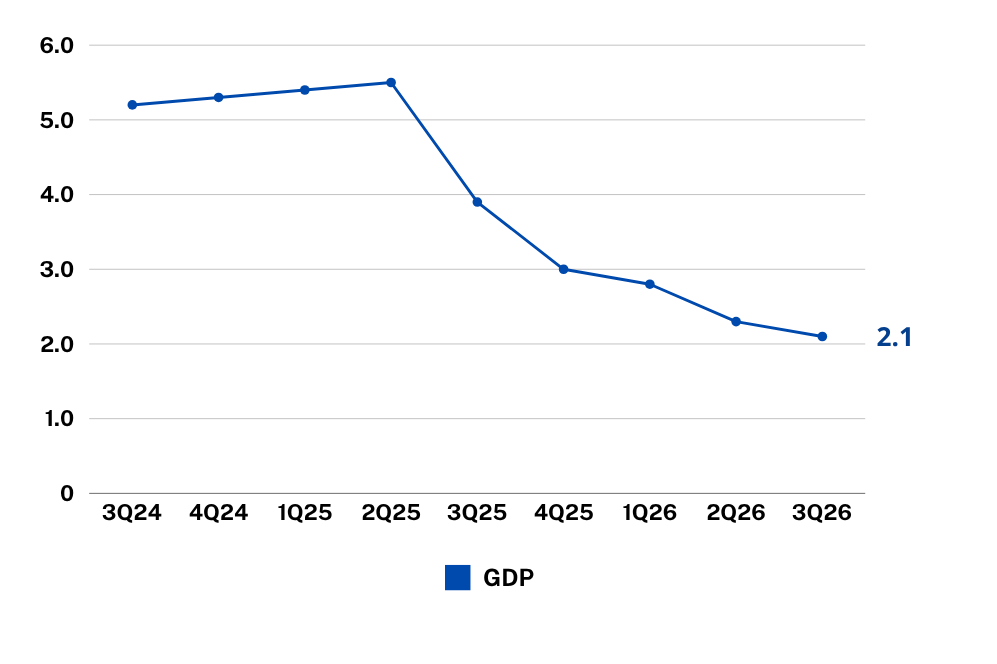
09 November 2026 — Philippine Gross Domestic Product (GDP) grew by 2.1% in the third quarter of 2026 lower than the previous quarter (2.4% in Q2 2026) and substantially lower than the same quarter in 2025 (4%). This is lower than the median forecast of economists for Q3 at 3%. The latest figure represents the weakest economic performance since the 3.8% contraction recorded in the first quarter of 2021 amid the pandemic. Setting aside the pandemic period, this marks the slowest growth in 16 years following the expansion of the economy to 1.8% in the fourth quarter of 2009.
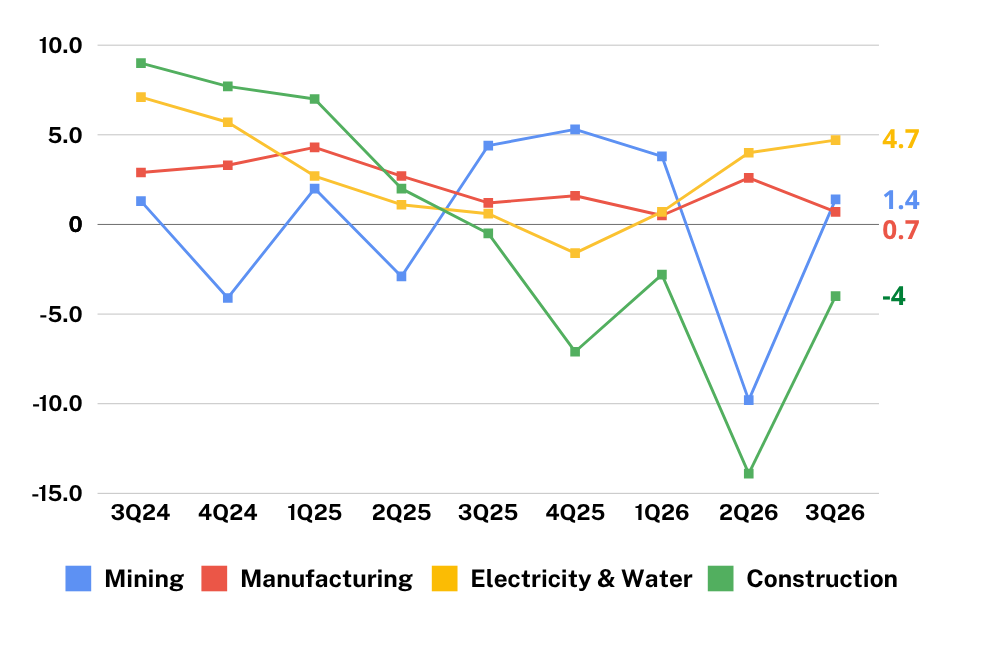
The GDP growth for this quarter remains well below the government’s 2026 growth target of 3.5% to 4.5%. With average growth for the first nine months at 2.5%, the Department of Economy, Planning, and Development (DEPDev) noted that the economy must grow by 6.3% in the fourth quarter to reach even the lower end of the target. The further slowdown in Q3 suggests that domestic economic activity remains under pressure, with weakness becoming more apparent across agriculture, industry, and household consumption, as high food and energy costs and weather disturbances continue to dampen growth.
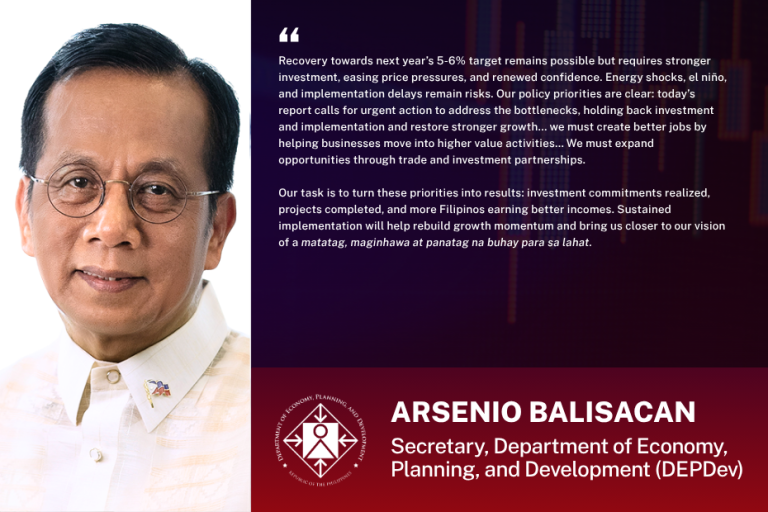
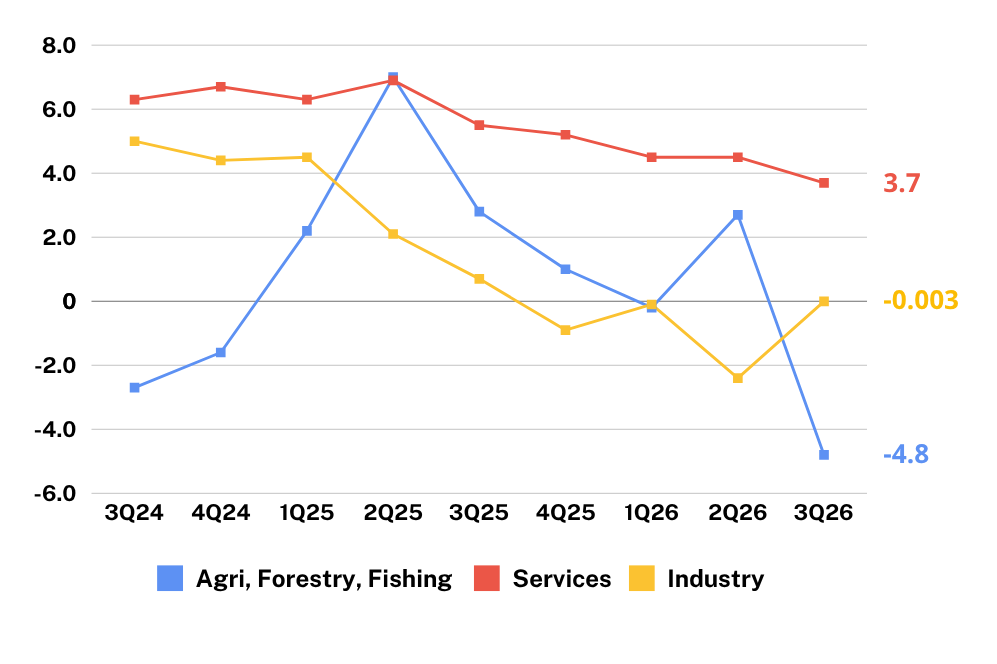
On the supply side, the services sector remains the primary driver of growth at 3.7%, contributing 2.5 percentage points to overall GDP growth. Meanwhile, the agriculture, forestry, and fishing sector contracted by -4.8%. According to DepDev Secretary Arsenio Balisacan this contraction was due to “tropical cyclones and enhanced southwest monsoon disrupted production. Palay and corn output fell by more than 17%, reducing rural incomes and adding to food supply measures.”
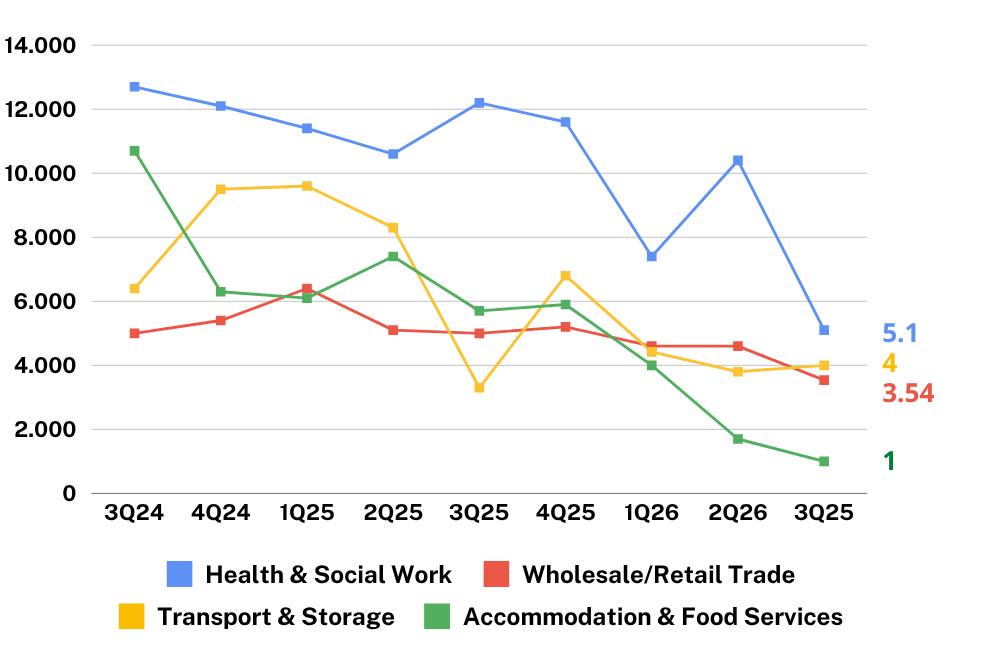
Industry was flat at -0.0%. Among industries, the fastest-growing sectors in Q3 2026 were Public Administration and Defense; Compulsory Social Security (+9.9%), Human Health and Social Work Activities (+5.1%), Electricity, Steam, Water and Waste Management (+4.7%), and Professional and Business Services (+4.6%). The largest contributors to overall GDP growth remained Wholesale and Retail Trade (0.8 percentage point), followed by Public Administration and Defense; Compulsory Social Security (0.5 percentage point), and Financial and Insurance Activities (0.4 percentage point).
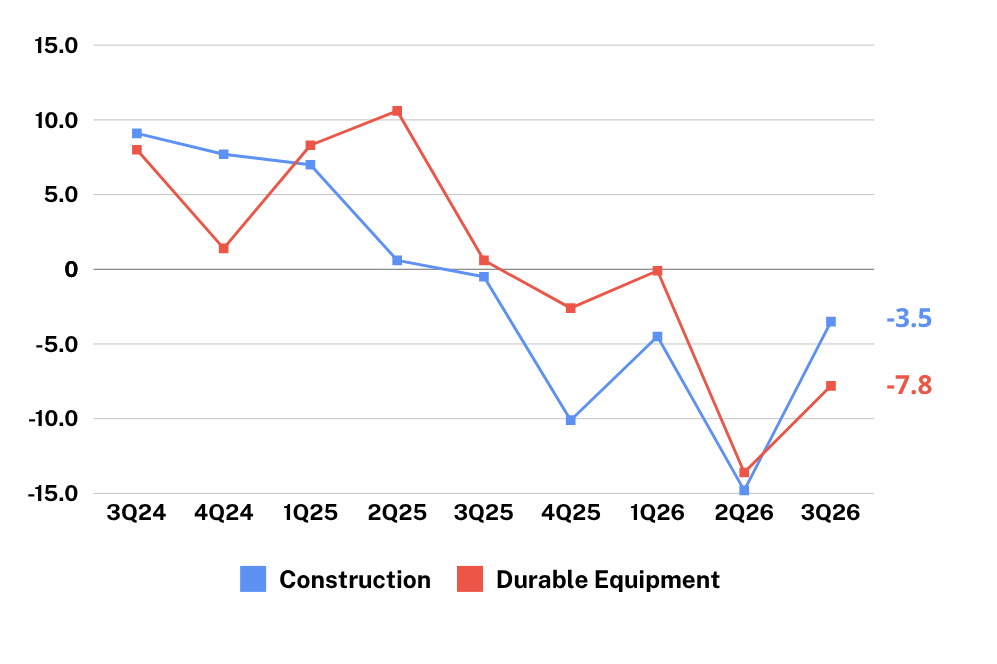
On the demand side, Exports of Goods recorded the fastest growth at 10.1% in Q3 2026. According to Sec. Balisacan this was due to exports growing by 8.6%, with electronics exports expanding by 19.4% amid demand for AI-related products. Meanwhile Imports of Services grew at 7.9%, followed by Imports of Goods (7.6%), and Government Final Consumption Expenditure (GFCE) (6.8%). Exports remained an area of strength, with total exports of goods and services growing by 8.6%, led by a 19.4% expansion in electronics exports due to strong global demand for AI-related products. However, Government consumption contributed 1.0 percentage point, down from 1.5 percentage points in the previous quarter, despite still posting solid growth. According to Sec. Balisacan, this is due to continued weakness in public construction and delays in project validation and payments. Household Final Consumption Expenditure (HFCE) remained the largest contributor to overall GDP growth at 1.7 percentage points, lower than its 1.9-percentage-point contribution in Q2 2026, as high food and energy costs continued to constrain household spending.
According to WR Numero Research’s October 2026 Philippine Public Opinion Monitor, 58.6% of Filipinos struggle to afford basic necessities at least weekly, while 83% experience difficulty meeting essential expenses at least monthly; meanwhile, 72.62% believe the country is heading in the wrong direction, up from 68% in June. This was echoed by the Congressional Policy and Budget Research Department (CPBRD) who cited that persistent weakness in domestic demand: household consumption, which accounts for the largest share of GDP, has decelerated for four consecutive quarters, while weak public investment has further constrained economic activity. UA&P likewise identifies slow National Government spending and elevated oil prices as key factors weighing on growth. In particular, infrastructure and other capital outlays fell by 34.6% to ₱522 billion in the first part of the year, from ₱798.4 billion in the comparable period in 2025. This contraction in public spending has weakened a key driver of economic activity, with delays in infrastructure implementation also affecting construction, investment and business confidence.
Renewed tensions between the United States and Iran have driven up global oil prices, prompting the Department of Energy to announce substantial fuel price increases effective September 8: ₱5.18 per liter for diesel, ₱4.69 for gasoline and ₱5.58 for kerosene. The increases were compounded by the peso’s depreciation against the US dollar, highlighting the Philippines’ vulnerability to external energy supply disruptions and exchange-rate fluctuations. The Asian Development Bank (ADB) has also identified the economic fallout from the conflict as a significant concern, cutting its 2026 Philippine growth forecast from 3.8% to 3.3%. However, the ADB recently approved a US$1.5-billion crisis-response loan to help finance the government’s UPLIFT program which will include fuel and fertilizer subsidies, transport assistance and cash transfers to vulnerable households and affected sectors. Other downside risks include climate-related disruptions, particularly the threat of a strong El Niño.
While exports have shown promising performance, reviving public infrastructure spending will be critical but targeted infrastructure investment must be prioritized. As Ayala Corporation Chairman and MBC Vice Chairman Jaime Augusto Zobel de Ayala (JAZA) noted during the Makati Business Club’s 45th anniversary, infrastructure is only useful if the right projects are built well, “with every project and peso fully accounted for.” Rebuilding momentum will thus require not just faster spending, but targeted and transparent infrastructure investments that contribute to the restoration of public trust and investor confidence.